How Indian Pharma Companies Are Using Mobile Apps to Scale Faster
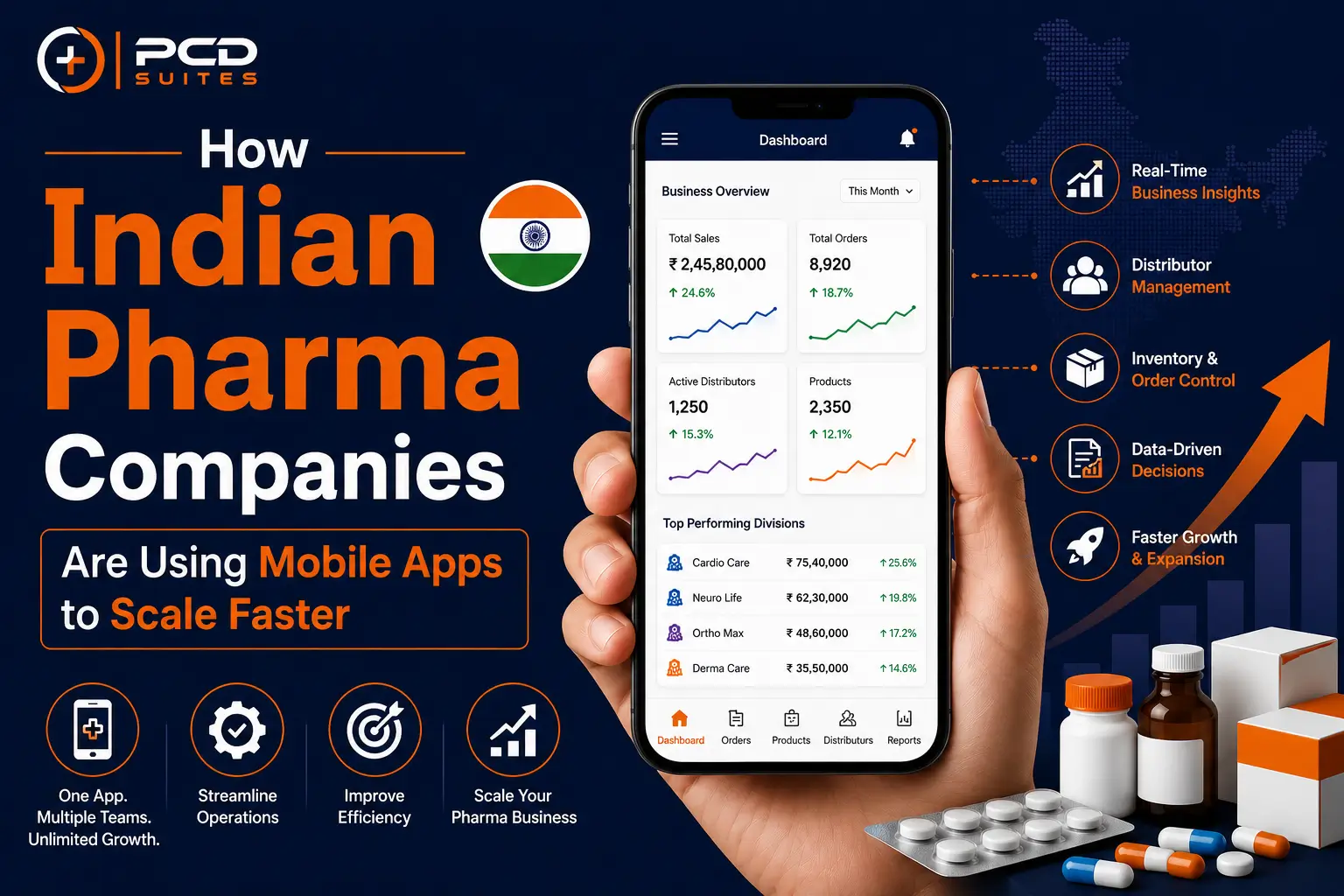
Here is a deep look at exactly how Indian pharma companies are using mobile technology to scale faster in 2026 and beyond. India’s pharmaceutical industry is on an aggressive growth trajectory. With a current market size of approximately US$ 58 billion and a stated target of US$ 130 billion by 2030, the race to scale has never been more intense. Yet for decades, the sector has relied on outdated processes — manual order books, field force visits tracked on paper, and distributor relationships managed entirely over phone calls.
That is rapidly changing.
Across India — from large-cap companies like Sun Pharma and Cipla to mid-size PCD franchise players and regional manufacturers — mobile apps are fast becoming the backbone of pharma business operations. Whether it is managing a 500-member field force, processing bulk B2B orders, or onboarding new franchise partners in Tier 2 cities, pharma companies are discovering that a well-built app does not just digitise a process — it multiplies the speed at which the entire business can grow.
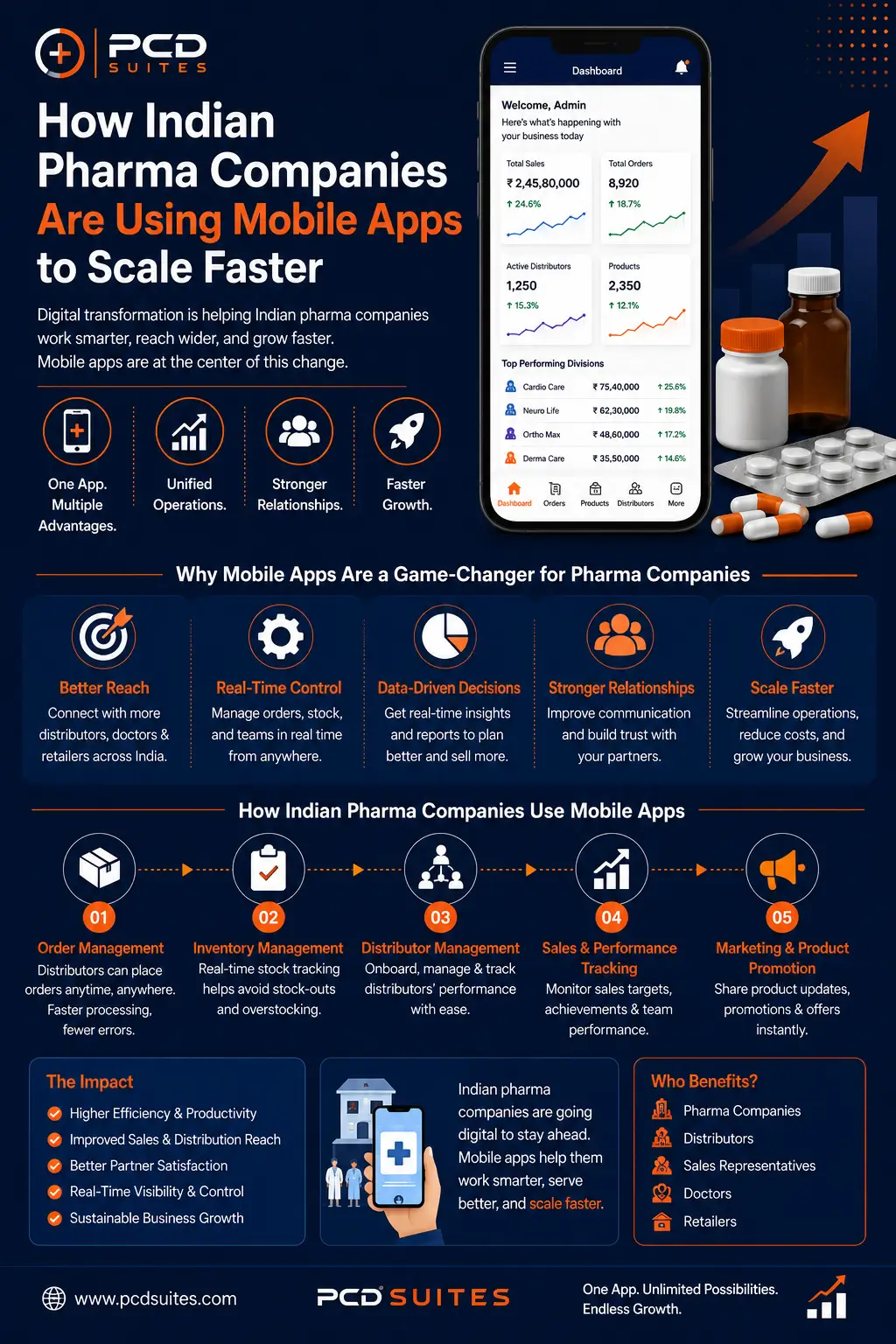
How Indian Pharma Companies Are Using Mobile Apps to Scale Faster
1. Field Force Management: From Chaos to Accountability
The most immediate pain point for any growing pharma company in India is managing its Medical Representatives (MRs) and field sales teams spread across geographies.
Traditionally, daily call reports (DCRs) were submitted manually, tour programmes were approved over WhatsApp, and managers had no real-time visibility into whether their MR actually visited the doctor’s clinic or sat at a tea stall.
Mobile apps built for pharma field force management have fundamentally changed this dynamic. Key capabilities include:
- GPS-tracked doctor visits with geo-tagged check-ins
- Digital DCR submission directly from the field
- Live tour programme approvals without back-and-forth emails
- Expense claim management with photo-based proof uploads
- Target vs. achievement dashboards for each MR, territory, and region
For a pharma company managing 200+ MRs across multiple states, this level of operational visibility is transformative. Managers can identify which territories are underperforming, which doctors are being neglected, and which MRs require coaching — all from a single dashboard, in real time.
The result: pharma companies using dedicated field force apps report measurably higher coverage rates, better detailing quality, and improved accountability without increasing headcount.
2. B2B Order Management: Cutting the Cycle from Days to Hours
In the traditional pharma supply chain, a distributor or stockist would place an order via phone call or WhatsApp message. The order would then be manually entered into a system, processed by the accounts team, verified by warehouse staff, and dispatched — a cycle that could take 48 to 72 hours and was prone to errors at every step.
Mobile-first B2B order management apps are collapsing this cycle dramatically.
Platforms like PharmaHopers (a B2B pharma marketplace) demonstrate this shift clearly. Through an app, a stockist in Ludhiana or a hospital purchase manager in Hyderabad can:
- Browse thousands of pharmaceutical products across categories
- View real-time pricing, MOQ (minimum order quantity), and availability
- Place orders directly with verified manufacturers
- Track order status and expected delivery
- Access GST invoices and payment history
For manufacturers and PCD franchise companies, listing on a B2B pharma marketplace app means instant access to a national buyer network — without needing to hire a large distribution team or attend trade fairs in every city. The app becomes the sales channel.
This is particularly powerful for small and mid-size pharma companies that lack the marketing budgets of Sun Pharma or Abbott India. A manufacturer in Baddi, Himachal Pradesh with WHO-GMP certification can now reach distributors in Tamil Nadu or West Bengal through an app, at near-zero cost per outreach.
3. PCD Franchise Onboarding and Support
India has over 3,000 PCD (Propaganda-Cum-Distribution) pharma franchise companies, and the model continues to grow. The challenge for most of them is managing franchise partners efficiently once they cross 50 to 100 partners across multiple states.
Mobile apps are solving the franchise lifecycle management problem end-to-end:
- Digital onboarding with document uploads (drug licences, GST certificates)
- Product catalogue access with updated pricing and schemes
- Order placement directly from the franchise partner’s mobile
- Marketing collateral downloads — visual aids, product cards, MR bags
- Monthly scheme and bonus communication pushed as notifications
For a PCD company with 300 franchise partners, replacing WhatsApp broadcasts with a dedicated app means fewer missed communications, reduced order errors, and significantly faster scheme rollouts. When a new product launches or a Diwali scheme goes live, every partner gets notified instantly — not just those who happen to check their WhatsApp at the right time.
4. Doctor CRM and Prescription Tracking
Understanding which doctors are prescribing which molecules — and acting on that data — is at the core of any pharma brand’s growth strategy. Yet most Indian pharma companies, especially mid-size ones, operate with very limited doctor-level intelligence.
Mobile CRM apps built for pharma are changing this. MRs can log:
- Doctor specialisation, patient load, and prescription habits
- Samples and gifts distributed
- Key concerns or objections raised
- Follow-up reminders and visit frequency preferences
This data, aggregated across a field force, gives marketing managers clear insights into which molecules have the strongest prescription pull, which doctors need more scientific engagement, and where competitor brands are gaining ground.
For pharma companies scaling into new therapy segments — say, moving from general practitioners into cardiologists or oncology — having a CRM-driven approach at the MR level makes market penetration significantly more structured and measurable.
5. Inventory and Compliance Visibility
As Indian pharma companies scale, two operational problems become critical: expiry management and regulatory compliance.
Modern pharma inventory apps allow warehouse teams and even field MRs to:
- Track batch numbers and expiry dates in real time
- Flag near-expiry stock for priority dispatch or return
- Monitor cold-chain compliance for temperature-sensitive products
- Generate batch-wise reports for audit readiness
Given that CDSCO and state drug authorities are increasingly strict about documentation — particularly for companies exporting to regulated markets — having a mobile-linked inventory system is not just convenient, it is a competitive necessity.
6. Patient and Consumer-Facing Apps: The Next Frontier
While most current mobile app adoption in Indian pharma is B2B and field-force focused, a growing number of companies are exploring direct-to-patient (D2P) apps — particularly in the chronic disease and wellness space.
Globally, medication adherence apps have been shown to improve patient compliance rates by up to 30%, and Indian companies in segments like diabetes management, thyroid care, and mental health are beginning to capitalise on this. Apps that provide dosage reminders, refill alerts, and teleconsultation access create a direct relationship with the end patient — a powerful competitive moat that traditional distribution models cannot replicate.
Online pharmacies in India are projected to grow at a 9.45% CAGR, and pharma brands that integrate their own ordering and engagement capabilities into mobile apps are well-positioned to capture a share of this shift.
What Separates Successful Pharma Apps from Failed Ones
Not every pharma company that has invested in an app has seen results. The common failure patterns are:
- Building an app instead of a solution — feature-heavy but not workflow-driven
- Poor adoption by field teams — no training, no incentive to use
- No integration with existing ERP or accounting software
- Neglecting the mobile UX — building a desktop interface that happens to run on a phone
The companies scaling fastest with mobile apps are those that start with a single, high-friction problem — usually order management or field force tracking — solve it well, and then expand the app’s scope based on actual user behaviour.
Conclusion
India’s pharmaceutical industry is targeting US$ 130 billion in sector revenue by 2030, and the companies that will reach that scale fastest are not necessarily those with the largest manufacturing plants or the biggest marketing budgets. They are the ones building digital infrastructure today — especially mobile apps that make their field force sharper, their order pipeline faster, and their distributor network more loyal.
Whether you are a PCD franchise company in Chandigarh, a specialty pharma manufacturer in Hyderabad, or a B2B marketplace connecting buyers and sellers across India, the mobile app is no longer a “nice to have.” In 2025, it is the growth lever that separates companies building for the next decade from those still operating like it is 2010.
FAQs
What types of mobile apps are most useful for Indian pharma companies?
Field force management apps, B2B order management platforms, PCD franchise portals, and doctor CRM apps are the most impactful for scaling operations in the Indian pharma market.
How do pharma mobile apps help PCD franchise companies grow?
They streamline partner onboarding, centralise product catalogues and scheme communication, enable direct order placement, and reduce dependency on WhatsApp-based informal workflows.
Is it necessary for small pharma companies to invest in a mobile app?
Even small manufacturers benefit from listing on existing B2B pharma marketplace apps, which provide instant access to a national distributor network without the cost of building a proprietary platform.
What is a B2B pharma marketplace app?
A B2B pharma marketplace app connects verified pharmaceutical manufacturers with distributors, stockists, and hospital procurement teams — enabling direct ordering, price discovery, and supply chain transparency on a single mobile platform.