How to Set MR Targets and Track Performance with a Pharma App
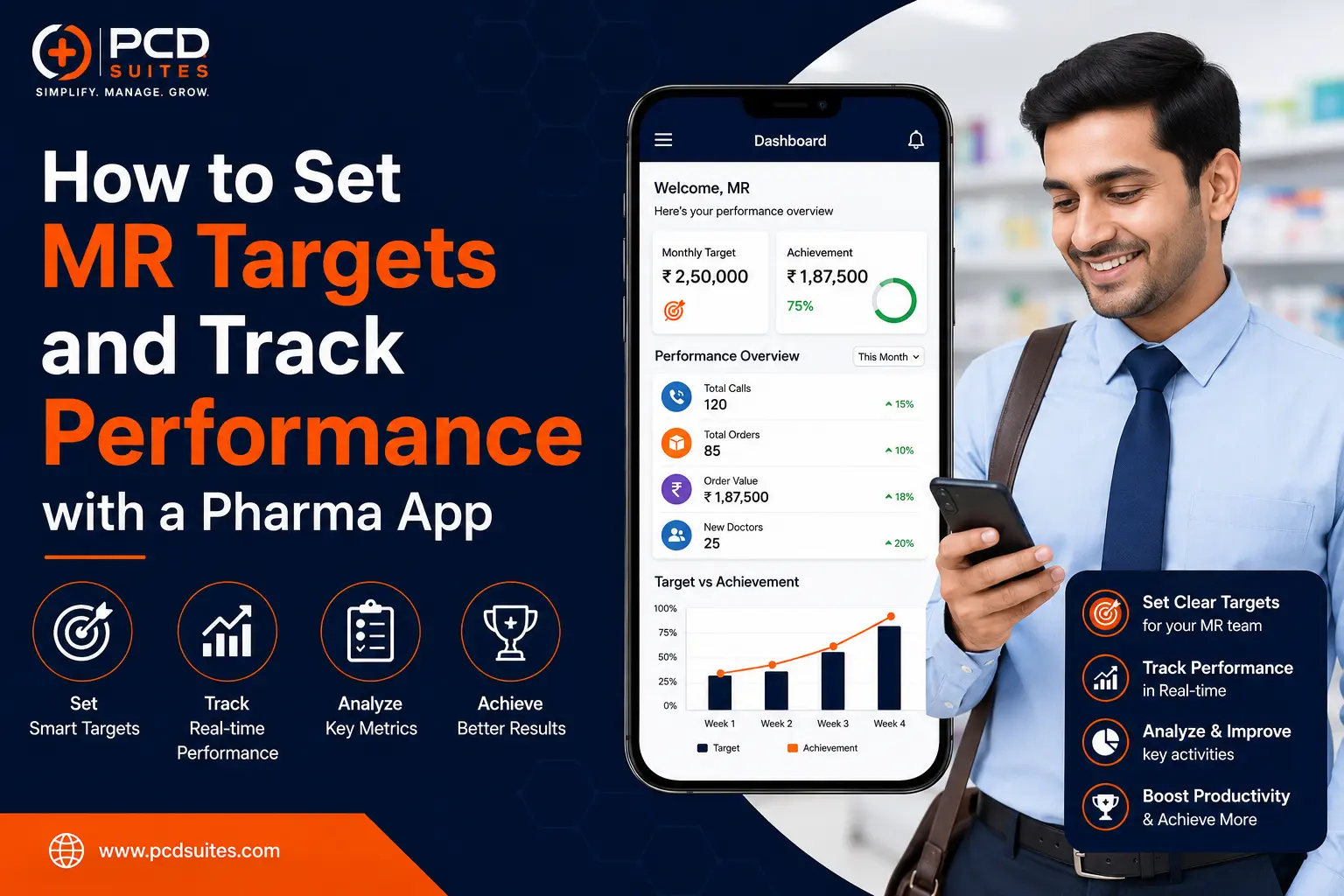
How to Set MR Targets and Track Performance with a Pharma App: Managing a pharmaceutical field force without clear targets is like prescribing medication without a diagnosis — well-intentioned, but unlikely to produce results. Medical Representatives (MRs) operate in one of the most competitive, compliance-driven, and data-intensive industries on the planet. Without structured targets and a robust tracking system, companies lose visibility into territory performance, waste resources on low-value activities, and fail to build meaningful relationships with healthcare professionals (HCPs).
The good news: modern pharma apps — built specifically for Sales Force Automation (SFA) and MR reporting — have transformed how pharmaceutical companies set goals, monitor field activities, and optimize sales force effectiveness.
This guide covers everything from target-setting frameworks to KPI dashboards, built on current industry data and best practices, so your field force can execute with precision.

The State of Pharma Sales Force Effectiveness in 2025–26
Before setting targets, it helps to understand the landscape your MRs are operating in. The numbers paint a challenging but navigable picture:
- Only one-third of sales calls are considered valuable by physicians, according to industry research — meaning two out of every three visits fail to create impact. (Pharma Sales Force Effectiveness – Everstage)
- More than 20% of physicians now restrict access to pharmaceutical representatives altogether.
- Nearly 90% of HCP interactions last less than two minutes, demanding that every second of rep time be purposeful.
- More than half of all HCP interactions now occur via digital channels — a milestone crossed in 2025 — shifting the role of the field rep toward omnichannel engagement.
- The global commercial pharmaceutical analytics market was valued at USD 5.16 billion in 2024 and is projected to reach USD 18.49 billion by 2031, signalling that data-driven field force management is no longer optional. (Pharma Sales Force Effectiveness, P360)
- 85%+ of biopharma executives plan to increase investment in data, AI, and digital tools.
These figures define the urgency. Companies that implement strategic territory design and app-based performance tracking see 18–25% improvements in sales force productivity and dramatically better HCP engagement outcomes.
What Are MR Targets in Pharma?
MR targets are quantified, and time-bound performance expectations are set for medical representatives across activity, coverage, and output dimensions. They fall into three broad categories:
1. Activity Targets
These measure what the MR does each day — the inputs that should eventually drive sales outcomes.
- Daily calls completed (versus tour plan)
- Number of doctors visited per day
- Chemist and stockist calls
- Samples distributed
- Promotional inputs delivered (visual aids, literature)
- CMEs, RTMs, and group meetings were conducted
2. Coverage Targets
These measure how thoroughly the MR reaches their assigned territory.
- Doctor coverage % (unique doctors visited vs. total territory list)
- Call frequency compliance by doctor class (A/B/C)
- New doctor additions per month
- Stockist coverage
3. Output/Sales Targets
These measure the downstream commercial results of MR activity.
- Monthly or quarterly product-wise sales value
- Market share in the territory
- Prescription generation (Rx target)
- Growth vs. same period last year (SPLY)
How to Set MR Targets: A Step-by-Step Framework
Step 1: Segment Your Doctor List (ABC Classification)
Before assigning any target, classify every doctor in each MR’s territory by prescribing potential. The standard classification is:
| Category | Prescribing Potential | Recommended Visit Frequency |
|---|---|---|
| A (Top) | High | 2x per month (fortnightly) |
| B (Mid) | Medium | 1x per month |
| C (Low) | Low | Once per quarter |
This classification directly informs call frequency norms and prevents MRs from over-visiting low-value contacts while neglecting high-prescribers. A good pharma app stores this segmentation and auto-alerts managers when frequency norms are violated.
Industry benchmark: Top prescribers should receive at least 2 visits per month; mid-tier at least monthly; lower-tier quarterly. Territories should be sized based on required monthly calls by prescriber decile.
Step 2: Apply the SMART Framework to Every Target
Targets that are vague or unmeasurable destroy motivation and make performance evaluation subjective. The SMART framework — widely endorsed in pharmaceutical sales management — ensures targets are actionable.
| SMART Element | Definition | MR Target Example |
|---|---|---|
| Specific | Clearly defined, no ambiguity | “Visit 25 doctors in the cardiology segment” |
| Measurable | Can be quantified | “Achieve 80% doctor coverage in territory” |
| Achievable | Realistic given territory size and working days | “Add 5–8 new doctors this month” |
| Relevant | Aligned to brand strategy | “Focus on 10 top cardiologists for new product launch” |
| Time-bound | Has a clear deadline | “By the 25th of each month” |
Example SMART MR target:“Achieve 90% call completion against tour plan, visit all ‘A’ category doctors at least twice, and add 6 new doctors to the active coverage list by the 30th of this month.”
Step 3: Set Territory-Level Activity Norms
Every MR target should be grounded in what is physically achievable in their territory. Standard norms vary by company and therapy area, but a useful starting baseline is:
- Calls per working day: 8–12 doctor calls (for typical pharma reps in field-intensive models)
- Working days per month: ~22–24 (after accounting for Sundays, holidays, HQ days)
- Monthly total calls: 180–250 calls per MR
- New doctor additions: 5–10 new doctors per MR per month is the industry benchmark, serving as a leading indicator for brand growth, especially for newly launched products
Step 4: Align Targets to Product Strategy
Different products at different lifecycle stages need different MR focus areas:
- New launches: Prioritise awareness calls, KOL engagement, CME execution, and new doctor additions.
- Growing brands: Focus on frequency compliance with top prescribers and market share gain.
- Mature/legacy brands: Emphasise stockist coverage, chemist relationships, and volume targets.
Your pharma app should allow product-wise target setting so managers can assign different call objectives, sample quotas, and input targets per brand in the MR’s bag.
Step 5: Cascade Targets Top-Down with Bottom-Up Validation
The most effective target-setting process runs in two directions:
- Top-down: National Sales Manager sets national targets → RSM allocates to regions → ABM/ASM sets territory targets for each MR.
- Bottom-up validation: MRs review their tour plan capacity, doctor list, and feedback any territory-specific constraints (access restrictions, seasonal demand).
A pharma app facilitates this by giving every layer of the hierarchy a consolidated view of territory data during the planning cycle.
Key KPIs to Track MR Performance with a Pharma App
Once targets are set, the pharma app becomes the central nervous system for performance tracking. Here are the critical KPIs every field force manager should monitor:
Primary Activity KPIs
| KPI | What It Measures | Why It Matters |
|---|---|---|
| Call Completion Rate | Actual calls vs. planned (tour plan adherence) | Measures field discipline and adherence |
| Doctor Coverage % | Unique doctors visited vs. territory list | Identifies coverage gaps |
| Call Frequency Compliance | Visits per doctor vs. target frequency by class | Ensures right doctors are prioritized |
| DCR Submission Rate | Daily Call Reports filed on time | Measures reporting hygiene |
| New Doctor Additions | Net new doctors added to active list per month | Leading indicator of brand growth |
Productivity and Output KPIs
| KPI | What It Measures |
|---|---|
| Sales vs. Target (%) | Actual secondary sales vs. monthly target |
| Rx Generation (Prescriptions) | New prescriptions generated per MR |
| Samples per Call | Sample efficiency vs. allocation |
| Input Effectiveness | Promotional inputs used vs. available |
| CME / RTM / SGD Execution | Group meetings conducted vs. planned |
Managerial KPIs (for ABM/RSM Level)
| KPI | What It Measures |
|---|---|
| Joint Visit Compliance | How often managers accompany MRs in the field |
| Team Coverage Heatmap | Visual representation of territory coverage |
| MR Productivity Ranking | Ranked view of call, coverage, and sales performance |
| Expense per Call | Input cost efficiency of field force |
A global pharmaceutical company with over 8,000 MRs improved ROI from 1.5% to 3.5% and enhanced field productivity through KPI-based performance management powered by AI analytics.
How a Pharma App Enables Target Setting and Performance Tracking
The pharma SFA/MR reporting app is the operational backbone of modern field force management. Here’s how leading apps handle the full target-to-tracking cycle:
Tour Plan Management and DCR Filing
Every MR begins their month by submitting a Tour Plan (TP) — a day-by-day schedule of doctors, chemists, and stockists they plan to visit. The app then records Daily Call Reports (DCRs) as the MR completes each visit.
Modern apps support:
- Offline DCR submission with automatic sync when connectivity resumes
- Geo-tagged visit verification (GPS confirms actual location at time of call)
- One-tap call logging to reduce admin burden on MRs
The right pharma app can reduce MR supervision time by 60% while increasing productive doctor visits by 40%.
Real-Time Performance Dashboards
Managers no longer need to wait for end-of-month reports. Pharma apps now deliver real-time dashboards that display:
- Live call completion vs. plan
- Territory coverage heatmaps
- Product-wise sales trend vs. target
- MR-level activity rankings
- Frequency compliance per doctor class
GPS-Based Field Activity Monitoring
GPS tracking within pharma apps allows managers to verify that visits are occurring at the declared location, reducing false reporting and improving accountability. All visit data is geo-tagged, creating an audit trail for compliance purposes.
Automated Alerts and Escalations
Smart pharma apps proactively alert managers when:
- An MR’s call completion drops below a threshold mid-month
- A high-priority doctor hasn’t been visited in 30+ days
- A target is unlikely to be achieved based on current pace
- DCR submission lapses beyond a set number of days
This shifts management from reactive monthly reviews to proactive, real-time course correction.
Doctor Segmentation and Call Planning Recommendations
AI-powered pharma apps can suggest next-best visits based on prescribing data, call history, and frequency compliance, ensuring MRs always know which doctor to visit next and why.
Choosing the Right Pharma App for MR Performance Tracking
The global MR Reporting Software market is projected to reach USD 3.5 billion by 2033, growing at a CAGR of 8.2% from 2025–2033 — reflecting the scale of investment pharma companies are making in field force technology.
When evaluating a pharma SFA app for your organization, look for these capabilities:
Must-Have Features
- Mobile-first design — MRs file DCRs from the field, not from a desk
- Offline functionality — field coverage is often in low-connectivity areas
- GPS-tagged visit logging — for verified field activity reporting
- Hierarchical dashboards — from MR level up to NSM level
- Tour plan vs. actuals tracking — real-time call completion monitoring
- Doctor and stockist master management — with classification and segmentation
- Product-wise target setting and tracking
- Expense management and claims
- Sample and input tracking
Advanced Features (For Growing Teams)
- AI-powered next-best-visit recommendations
- Automated performance scorecards
- Integration with ERP and secondary sales data
- CME and event management
- WhatsApp or in-app communication with HCPs
- Predictive analytics for territory potential
Common Mistakes in MR Target Setting (and How to Avoid Them)
Mistake 1: Setting Uniform Targets Across All Territories
No two territories are identical. An MR in a metro with 500 doctors in their list shouldn’t have the same coverage target as an MR in a rural territory with 80. Targets must be territory-normalized.
Fix: Use territory potential data and doctor list size to calibrate targets individually for each MR.
Mistake 2: Tracking Activity Without Linking to Outcomes
High call counts don’t always produce results. If an MR is visiting 12 doctors a day but generating no new prescriptions, activity-only tracking misses the problem.
Fix: Track both leading indicators (calls, coverage, frequency) and lagging indicators (Rx, sales vs. target) in your dashboard.
Mistake 3: Ignoring Call Frequency Compliance
Many managers track coverage percentage but ignore frequency — resulting in MRs visiting 90% of their doctor list once while never building relationships with high-potential prescribers.
Fix: Enable frequency compliance tracking in your pharma app segmented by doctor class (A/B/C), and set alerts when frequency norms are missed.
Mistake 4: Changing Targets Mid-Month Arbitrarily
Mid-cycle target revisions (without territory events like product shortages or market changes) destroy trust and make performance evaluation meaningless.
Fix: Establish a target-setting calendar. Set targets before the 1st of each month. Allow revisions only through a formal process with documented rationale.
Mistake 5: Not Using App Data in Monthly Performance Reviews
Many companies use a pharma app to collect data but still conduct monthly reviews based on manually compiled Excel sheets. This defeats the purpose.
Fix: Run all 1:1 reviews and team performance discussions directly from the app’s dashboard. Train managers to use live data, not lagging summaries.
Step-by-Step: Implementing Target Tracking with a Pharma App
Here is a practical implementation roadmap for a field force manager deploying app-based MR tracking for the first time:
- Step 1 — Set Up Doctor Master: Upload the complete doctor list for each MR’s territory with classification (A/B/C), specialty, and visit frequency norms.
- Step 2 — Define Product Targets: Enter monthly product-wise sales targets and sample/input allocations per MR in the system.
- Step 3 — Configure Tour Plan Templates: Set working day norms, HQ day rules, and holiday calendars. Enable tour plan submission workflows.
- Step 4 — Train MRs on Daily DCR Filing: Run a 2-hour onboarding session on mobile app usage. Enforce the rule: no DCR = no call credit.
- Step 5 — Activate Manager Dashboards: Ensure every ABM and RSM has access to their team’s real-time performance dashboard on both mobile and web.
- Step 6 — Set Up Automated Alerts: Configure alerts for call completion drops, missed high-priority doctors, and late DCR submissions.
- Step 7 — Conduct Weekly Pulse Reviews: Use app data every Monday morning for a 15-minute team check-in on coverage, pace vs. target, and course corrections.
- Step 8 — Run Formal Monthly Reviews from App Data: Make the MR performance dashboard the single source of truth for all appraisal, incentive, and coaching conversations.
FAQ
What is a realistic daily call target for a medical representative?
The standard benchmark for pharma MRs is 8–12 doctor calls per working day, depending on the geography (metro vs. rural), therapy area, and company’s call norm policy. Companies should validate call targets against tour plan capacity — an unrealistic daily call norm leads to falsified DCRs, which destroys the value of your tracking data.
How often should MR performance targets be reviewed?
Targets should be set monthly and reviewed in a formal monthly performance conversation. However, weekly pulse checks using real-time app dashboards allow managers to course-correct before month-end rather than reviewing failures after the fact.
What is call frequency compliance and why does it matter?
Call frequency compliance tracks whether each doctor is being visited at the rate prescribed by their classification (A = fortnightly, B = monthly, C = quarterly). It goes beyond coverage percentage — an MR can achieve 90% doctor coverage but still fail frequency compliance if they’re visiting all doctors once instead of prioritizing ‘A’ doctors twice. This is one of the most important metrics for building consistent prescribing behaviour among HCPs.
Can a pharma app verify that MR visits are genuine?
Yes. Modern pharma SFA apps use GPS geo-tagging to record the location of each DCR submission. Managers can view whether a call was logged from the doctor’s clinic address or from an unrelated location. Some apps also capture check-in and check-out times to verify visit duration.
What is the typical ROI of implementing a pharma SFA app?
Companies typically see ROI within 3–6 months of deployment. Reported outcomes include a 60% reduction in MR supervision time, a 40% increase in productive doctor visits, and, in documented cases, improvement in overall field force ROI from 1.5% to 3.5% through improved KPI tracking and territory management.
How many new doctors should an MR add per month?
Industry benchmarks suggest 5–10 new doctors per MR per month, varying by product lifecycle stage and therapy area. New doctor additions are a leading indicator — they predict future prescription growth before it shows up in sales data.
Conclusion
Setting MR targets without a structured framework is guesswork. Tracking performance without a pharma app is management in the dark. Together, a SMART target-setting process and a capable SFA application create the conditions for field force excellence — where every call counts, every territory is accountable, and managers have the data to coach rather than guess.
The pharmaceutical industry’s shift toward digital field force management is accelerating. With more than 85% of biopharma executives investing in data and AI tools, companies that delay app adoption risk falling behind competitors who already have real-time visibility into every call, every territory, and every doctor relationship.
Start with clear ABC doctor segmentation, set SMART targets at the territory level, and use your pharma app as the single source of truth for performance. The result: a field force that is not just active, but effective.